
Float therapy and Ayurveda are connected through their shared focus on deep relaxation, sensory withdrawal (Pratyahara), and balancing Vata dosha. Both approaches use stillness, warmth, and natural elements to calm the nervous system and restore physical and mental equilibrium.
India has always known that stillness heals. Long before the concept of float therapy arrived on global wellness radars, Indian civilization was already mapping the relationship between the body, the mind, water, and silence. Ayurveda, one of the oldest living health systems in the world, has spent thousands of years articulating what many modern wellness seekers are only now beginning to discover. So when you peel back the layers of what a sensory deprivation tank actually offers, something familiar starts to emerge. Something deeply, unmistakably Indian.
What Is Float Therapy, Really?
Float therapy benefits include reduced stress, improved sleep, muscle recovery, and nervous system regulation. By using a sensory deprivation tank, the body enters a deeply restorative state similar to advanced meditation practices.
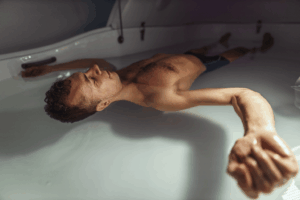
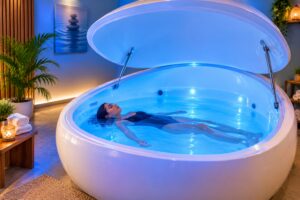
Float therapy involves lying in a pod or pool filled with water saturated with Epsom salt (magnesium sulphate). The salt concentration is so dense that your body floats effortlessly, without any effort or tension. The water is heated to skin temperature. The environment is dark, silent, and still. For 60 to 90 minutes, your nervous system has absolutely nothing to fight against, process, or react to.
What’s left is just your breath, your heartbeat, and whatever your mind decides to do with the quiet. For many first-time floaters, the experience is mildly unsettling before it becomes deeply restorative. For those with chronic stress, muscle pain, anxiety, or simply the relentless overstimulation of modern urban life, it can feel like the nervous system finally exhales for the first time in years.
Ayurveda’s Take on Water, Stillness, and the Body
Float therapy Ayurveda connections are not forced or superficial they emerge naturally when you look at what both systems are fundamentally trying to achieve.
Ayurveda, at its core, is a science of balancing one of the world’s oldest living medical traditions with deeply documented principles and a rich history rooted in the Indian subcontinent. It recognises three primary biological forces Vata, Pitta, and Kapha that govern all physical and mental functions. When these doshas fall out of balance, illness follows. When they are in harmony, health flows.
Water, in Ayurveda, is not just a physical element. It is Jala, one of the Panchamahabhuta, the five great elements. It is associated with nourishment, cohesion, softness, and the quality of letting go. Therapeutically, water has always held a central place in holistic healing India traditions, used for internal cleansing (Panchakarma), oil treatments, steam therapies, and ritual bathing.
The idea that immersing the body in a controlled, nourishing aquatic environment can restore equilibrium is not new to Indian medicine. It is ancient.
The Vata Connection: Why So Many Indians Need to Float
Here is where it gets particularly relevant to contemporary Indian life.
Vata dosha governs movement, nervous system activity, thought, and communication. It is associated with the elements of air and space and in the modern world, Vata is almost universally aggravated. Traffic noise, blue screen exposure, irregular eating, fast-paced cities, financial anxiety, social media scrolling all of these are textbook Vata aggravators.
Symptoms of excess Vata? Anxiety, insomnia, scattered thinking, dry skin, irregular digestion, muscle tension, and an inability to truly rest.
Sound familiar?
Float therapy, by design, is one of the most powerful Vata-pacifying experiences available. The warm, dense water grounds the body. The elimination of external stimulation quiets the overactive nervous system. The darkness removes the constant need for visual processing. The silence interrupts the loop of mental noise. Floating is, in Ayurvedic terms, deeply tamasic in the best possible sense; it creates the conditions for the body and mind to settle, consolidate, and restore.
Snehana: The Ancient Ritual of Oleation and Its Modern Parallel
Panchakarma, Ayurveda’s most comprehensive detox and restoration protocol has been studied as a holistic health intervention with measurable effects on stress, behaviour, and overall well-being. It involves several preparatory and therapeutic stages, one of the most important being Snehana, or oleation.
The logic behind Snehana is that lubrication and warmth open channels, relax tissues, and allow the body to release what it has been holding onto.
Float therapy is not oil-based, but the physiological and experiential parallels are striking. The warm, mineral-dense water in a sensory deprivation tank creates a soft, enveloping pressure on the skin. Magnesium is absorbed transdermally during a float session, relaxing muscles and supporting nervous system function. The entire body is held in a state of effortless warmth and buoyancy, a kind of liquid Snehana.
Even the emotional release that many people experience during or after a float of unexpected grief, deep relief, creative insight mirrors what Ayurvedic practitioners describe after intensive Snehana: the body not just relaxing physically, but releasing stored emotional residue.
Pratyahara: Withdrawal of the Senses as Spiritual Practice
One of the eight limbs of classical yoga, described in Patanjali’s Yoga Sutras, is Pratyahara, the withdrawal of the senses from external objects. It is the bridge between the outer practices of yoga (asana, pranayama) and the inner practices (dharana, dhyana, samadhi). Without Pratyahara, the mind cannot truly turn inward, because it is constantly being pulled outward by sensory input.
A sensory deprivation tank is, in practical terms, a technology that enforces Pratyahara.
When there is no light to see, no sound to process, no surface to feel, no temperature differential to register, the senses have nothing to grasp. The mind often with some resistance at first begins to release its grip on the external world and turns back on itself. Meditators who have struggled for years with a restless, distracted mind often report that floating unlocks a depth of stillness they had never been able to access through seated practice alone.
This is not a coincidence. This is Indian wellness philosophy working exactly as it was designed, expressed through a contemporary medium.
Magnesium, Minerals, and Ayurvedic Mineral Therapies
Ayurveda has long recognised the therapeutic value of minerals. The branch of Ayurvedic medicine that deals with mineral-based preparations is called Rasa Shastra, an entire science of purifying and using metals, minerals, and gems to restore health.
Magnesium, though not always named by that term in classical texts, corresponds to minerals that support the nervous system, ease muscle tension, improve sleep, and balance Vata. Its transdermal absorption through float therapy aligns naturally with the Ayurvedic belief that the skin is a site of healing, not just a barrier. Abhyanga the practice of self-massage with warm oil works on this exact same principle: the skin as a channel for therapeutic input.
The Urban Indian and the Need for Deliberate Stillness
India’s metro cities Mumbai, Delhi, Bengaluru, Pune, Hyderabad are among the most overstimulating environments on the planet. Noise levels, population density, work pressure, commute times, and digital connectivity have created a generation of Indians who are perpetually “on.” Burnout, anxiety, and lifestyle disorders are no longer exceptions. They are norms.
Holistic healing India has a rich indigenous toolkit for addressing this yoga, pranayama, Ayurvedic treatments, meditation retreats, sound baths. Float therapy is a powerful addition to this toolkit. Not a replacement for traditional practices, but a complementary one that works precisely because it does something that modern life makes almost impossible: it gives the nervous system complete, uninterrupted permission to stop.
Coming Back to Yourself
The deepest insight that both float therapy Ayurveda traditions share is this: healing is not always about adding something. Often, it is about removing obstruction, the noise, the tension, the constant reactivity and trusting that the body knows how to restore itself when given the right conditions.
India has understood this for millennia. The sensory deprivation tank is, in many ways, a modern architecture for an ancient truth.
At Secret Soak Society, this understanding is at the heart of everything that float therapy is not a luxury or a novelty, but a return. A return to stillness, to mineral warmth, to the self beneath the noise. For anyone in India curious about where ancient Indian wellness wisdom meets contemporary science, Secret Soak Society offers a space to begin that journey one float at a time.
FAQs – (Frequently Asked Questions)
Q1. What is float therapy and how does it work?
Float therapy involves lying in a pod filled with Epsom salt water that makes your body effortlessly buoyant in a dark, silent environment. The complete removal of sensory input allows your nervous system to deeply rest and recover.
Q2. Is float therapy related to Ayurveda?
Yes, both systems share the core belief that removing external stimulation and nourishing the body through warmth and minerals restores natural balance. Concepts like Snehana, Pratyahara, and Vata-pacification in Ayurveda closely mirror what float therapy achieves scientifically.
Q3. What are the benefits of float therapy for stress and anxiety?
Multiple NIH-indexed clinical studies show that float therapy significantly reduces cortisol levels, lowers blood pressure, and decreases symptoms of anxiety and depression. Regular sessions help the nervous system shift from a constant fight-or-flight state into deep, sustained relaxation.
Q4. Is sensory deprivation tank therapy safe in India?
Yes, float therapy is a non-invasive, drug-free wellness practice with no serious side effects reported in clinical trials. It is not recommended only for those with epilepsy, claustrophobia, open wounds, or very low blood pressure.
Q5. How is float therapy different from a regular spa or massage?
Unlike a massage or spa treatment, float therapy requires zero physical contact and works entirely through sensory elimination rather than external stimulation. It targets the nervous system at a neurological level, producing a depth of relaxation that most conventional spa treatments cannot replicate.