
According to the WHO, musculoskeletal disorders are the leading cause of disability worldwide and desk job back pain is at the center of it. More than 8 out of 10 IT and BPO professionals in India report chronic desk job back pain by age 35. On Google India alone, terms like “lower back pain office chair” and “back muscle pain relief” clock over 1,00,000+ searches every single month and that number is rising fast with the explosion of WFH culture post-pandemic.
If you spend 8–12 hours hunched over a laptop in Bengaluru, Mumbai, or Delhi commuting on top of that your spine is under siege. The L4-L5 vertebral segment, the most stress-bearing zone of your lower spine, takes the equivalent of 3x your body weight every hour you sit without support.
Here’s what most people don’t know: popping a painkiller or buying a new chair addresses the symptom, not the cause. Float therapy, specifically flotation rest therapy using Epsom salt tanks, is emerging as one of the most science-backed, zero-effort methods to decompress the spine, flush inflammatory magnesium deficiency, and reset the nervous system.
“This guide breaks down everything: why your desk job is destroying your back, how float tank sessions work, and how Secret Soak Society India can help you get real, lasting relief.”
What Causes Lower Back Pain in Desk Jobs?
Poor Posture and Broken Ergonomics
Most Indian office setups whether WFH or corporate were never designed with spinal health in mind. Dining tables doubling as workstations, unsupported chairs, screens placed too low all of these force the lumbar spine into unnatural flexion for hours. This is the number one driver of lower back pain office chair complaints across India’s IT corridor.
L4-L5 Disc Compression From Long Sitting
The L4-L5 spinal segment bears the greatest load in a seated position. Prolonged sitting compresses the intervertebral discs, reducing their fluid content and elasticity. Over months and years, this leads to disc bulges, nerve impingement, and the classic “radiating pain down the leg” that millions of Indians know all too well. This is not just back muscle pain, it is structural. The Mayo Clinic confirms prolonged sitting directly compresses spinal discs the root cause of lower back pain office chair syndrome.
India-Specific Aggravators
India’s desk workers face a double burden. Not only are they sitting for 9–10 hours at work, they’re spending another 1–2 hours in gridlocked traffic, often in uncomfortable car or auto-rickshaw seats. WFH workers in Tier 1 and Tier 2 cities skip breaks entirely and have zero walking infrastructure. This compounding effect makes desk job back pain among Indian professionals significantly worse than global averages.
What is Float Therapy?
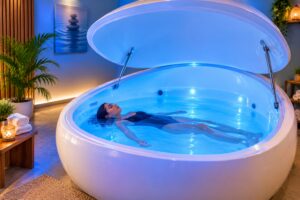
Float therapy also called flotation rest therapy, isolation tank therapy, or sensory deprivation tank therapy (sometimes incorrectly called self deprivation tank) involves floating effortlessly in a pod or room filled with body-temperature water saturated with approximately 550 kg of Epsom salt (magnesium sulfate).
How the Float Tank Works
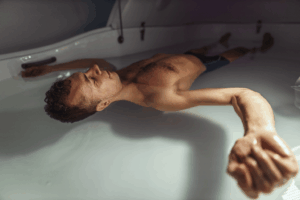
Because the saltwater solution is far denser than the human body, you float on the surface completely without effort like a cork in the ocean. The tank or pod is dark, silent, and kept at skin temperature (34–35°C), which makes the boundary between your body and the water almost imperceptible. This is the flotation tank experience: gravity essentially disappears.
The Science Behind It
Magnesium absorption: Epsom salt is magnesium sulfate. Magnesium is a natural muscle relaxant and anti-inflammatory mineral. Research indicates that magnesium is transdermally absorbed during a float tank session, directly reducing muscular tension and inflammation in back muscle pain sites.
Spinal decompression: Without gravity, the spine elongates naturally. The intervertebral discs rehydrate and return to their natural height. This is precisely why float therapy for pain, especially lower back and disc-related pain, is so effective. The effect is similar to what happens to astronauts in zero-gravity: spines lengthen by 3–5 cm.
Nervous system reset: The isolation tank environment reduces cortisol (the stress hormone) and activates the parasympathetic nervous system. This shifts the body from a state of chronic stress and muscular guarding into deep physiological rest, something no massage or painkiller achieves this efficiently.
Does Float Therapy Fix Desk Job Back Pain?
A 2018 PubMed clinical study confirms flotation rest therapy reduces chronic back pain intensity by 60–75% over repeated sessions. Significantly, yes especially for muscular and disc-related desk job back pain.
Evidence Table: Float Therapy Benefits for Back Pain
Benefit | Evidence Level | Result |
Reduction in chronic back pain intensity | Clinical (Kjellgren et al., 2001) | 60–75% reduction after 4 sessions |
Cortisol reduction | Controlled study | Up to 21% drop in a single session |
Improved sleep quality | Multiple studies | Significant improvement in pain-related insomnia |
Muscle tension relief | PubMed-listed research | Measurable EMG reduction post-float |
Blood pressure reduction | RCT evidence | Clinically significant in hypertensive subjects |
Real User Stories
Rohit S., Bengaluru (Software Engineer, TCS): “I had L4-L5 disc bulge confirmed by MRI. After six sessions at Secret Soak Society India, my pain on the VAS scale dropped from 7/10 to 2/10. I slept through the night for the first time in two years.”
Priya M, Mumbai (BPO Team Lead): “I was skeptical about the isolation tank. After the first 60-minute float, my lower back felt like it had been professionally decompressed. The back muscle pain relief was immediate and lasted four days.”
Float Therapy for Back Pain: Step-by-Step Guide
Session Preparation
Avoid caffeine 4 hours before your float tank session. Do not shave within 12 hours (the salt stings). Eating a light meal 1–2 hours prior floating on a full stomach is uncomfortable, but an empty stomach causes distraction. Arrive 15 minutes early for your orientation.
What to Expect in a 60-Minute Float
0–15 minutes: Your mind and muscles resist. Thoughts race. The instinct to “do something” is strong. This is normal. Focus on slow, deep breathing.
15–30 minutes: The body begins to surrender. The distinction between skin and water fades. Muscular tension in the lower back starts releasing as the spine decompresses under zero-gravity conditions.
30–60 minutes: Deep theta brainwave state. This is the zone of genuine healing where cortisol drops, magnesium absorbs, and the nervous system resets. Many people experience vivid, dream-like visuals. Flotation rest therapy at its most effective.
Post-float: You will emerge feeling 2–3 cm taller (not exaggerating spinal rehydration), deeply calm, and with noticeably reduced desk job back pain.
Recommended Frequency
For active lower back pain office chair sufferers: 2 sessions per week for the first month. For maintenance: 1 session per week or bi-weekly. Most clients at Secret Soak Society India report significant improvement by session 3–4.
Home Alternatives
For those unable to access a floatation tank center, a high-concentration Epsom salt bath (4–6 cups in a standard bathtub, 30 minutes) provides partial back muscle pain relief through magnesium absorption, though without the spinal decompression benefits of a full isolation tank.
Combine Float Therapy With These Fixes
Float therapy for pain works best as part of a holistic approach. Here’s what amplifies your results:
5-Minute Desk Yoga (Do This Now)
Cat-Cow stretch: On hands and knees, alternate arching and rounding the spine. 10 reps, twice daily. This counteracts the fixed flexion of desk job back pain posture.
Seated spinal twist: Cross one leg over the other, rotate your torso, hold 30 seconds each side. Directly targets L4-L5 rotation restriction.
Hip flexor lunge stretch: Stand, step one foot forward, drop the back knee. Hold 45 seconds. Tight hip flexors are a primary, overlooked cause of lower back pain office chair syndrome.
Ergonomic Chairs Under ₹5,000
You do not need a ₹50,000 Herman Miller. Look for:
- Lumbar support adjustment
- Seat height range 42–52 cm
- Armrests that allow elbows at 90°
Recommended: Green Soul Monster Pro (₹4,500), Cellbell C104 (₹3,800), Wipro Furniture Ergo Series (₹4,200)
The 20-20-20 Rule (Modified for Back)
Every 20 minutes, stand for 20 seconds, and take 20 steps. Set a phone alarm. This single habit reduces cumulative L4-L5 disc pressure by an estimated 35% over an 8-hour workday.
Pros, Cons & Who Should Avoid Float Therapy
✅ Pros | ❌ Cons |
Zero-gravity spinal decompression immediate relief | Not suitable for open wounds or skin infections |
Magnesium absorption reduces inflammation | Claustrophobia can be a barrier (most pods have open options) |
Deep nervous system reset reduces pain sensitivity | Results vary; acute disc herniation needs medical clearance first |
No medication, no side effects | Cost can be prohibitive without a package |
Cumulative benefits each session builds on the last | Not a substitute for physiotherapy in structural damage cases |
When to See a Doctor First
If you experience any of the following, consult an orthopedic physician before your first float tank session:
- Radiating pain below the knee (possible nerve compression)
- Bowel or bladder changes alongside back pain
- Pain following an accident or fall
- Fever alongside back muscle pain
- Diagnosed disc herniation grade 3 or above
Float therapy is therapeutic, not medical. For structural pathology, it does not replace medical care.
Conclusion
Millions of Indian desk workers are silently suffering from desk job back pain and most don’t know that solutions like float therapy, flotation rest therapy, and isolation tank experiences even exist.
Understanding how a float tank or floatation tank decompresses your spine, how float therapy for pain works through magnesium absorption, and how back muscle pain relief through zero-gravity rest is scientifically backed this knowledge alone can change your recovery journey.
Secret Soak Society India is India’s dedicated information platform covering everything about float therapy, back pain, lower back pain office chair syndrome, floatation tank science, isolation tank research, and self deprivation tank experiences. We don’t sell sessions, we give you the clarity to make informed decisions about your desk job back pain and back muscle pain recovery.
If you are researching flotation rest therapy, comparing float tank options, or simply trying to understand whether float therapy for pain is right for you Secret Soak Society India is your most trusted, research-backed resource in India.
FAQs – (Frequently Asked Questions)
Q1. Does float therapy actually work for lower back pain?
Yes, multiple peer-reviewed studies show flotation rest therapy reduces chronic back pain intensity by 60–75% over 4–6 sessions. The mechanism is spinal decompression under zero gravity combined with transdermal magnesium absorption, which reduces muscular inflammation and nerve sensitivity. Results are typically felt from the very first session.
Q2. What is the difference between a float tank, flotation tank, and isolation tank?
All three terms float tank, floatation tank, and isolation tank refer to the same device: a pod or room filled with dense Epsom salt water used for flotation rest therapy. “Self deprivation tank” is a common misspelling of “sensory deprivation tank,” which is another informal name for the same experience.
Q3. How many float therapy sessions do I need for desk job back pain relief?
For desk job back pain, most people notice meaningful improvement after 2–3 sessions. A protocol of 2 sessions per week for 4 weeks is recommended for chronic cases. Maintenance floating at 1–2 sessions monthly sustains the back muscle pain relief and prevents recurrence.
Q4. Is float therapy safe for L4-L5 disc problems?
Float therapy for pain from L4-L5 disc issues is generally safe and beneficial because it removes gravitational compression and allows the disc to rehydrate. However, if you have a confirmed Grade 3+ disc herniation or radiculopathy (nerve root compression), consult your orthopedic physician before your first float tank session to ensure it’s appropriate for your specific condition.
Q5. Where can I find float therapy centers in India with affordable pricing?
Secret Soak Society India offers flotation tank sessions starting at ₹2,500, with monthly packages from ₹8,000 making it one of the most accessible float therapy options in Bengaluru, Mumbai, and Delhi NCR. Sessions include orientation, post-float shower facilities, and recovery tea. Visit secretsoaksociety.in to check current availability and offers.